I was familiar with both Eisner and The Spirit before taking this class, but I didn't know much about either. Eisner was that guy that did Disney stuff and The Spirit was just another hard to follow strip comic like Dick Tracy. After reading both some Spirit and some Eisner, I can really appreciate it more. Will Eisner creates deep stories with very little, and the Spirit feels like a detective noir than a beat cop with mask.
I wasn't sure what to expect from Eisner when I first started a "A Contract With God." The title itself is a very heavy idea and given the size of the entire book I was a little put off. Fortunately when I cracked it open , I very much enjoyed myself. Eisner's status as a master was not unrequited. The illustrations where brilliant in how they took a a large action and distilled its entirety into one frame so easily. This is even more impressive with the characters themselves. In "A Contract With God," a lot of emotion is thrown around. The struggle to keep to your faith in odds of the troubled times and a self regulated life style, only to break down and give into lesser pursuits. Thats really heavy stuff to express in writing let alone in illustration. Yet, Eisner shows his expertise in a way that doesn't seem overbearing. In fact the entirety of the piece was dripping with a style that I can now only attribute to Eisner. Characters appear stilted towards their personality in a way one can immediately relate their character just by a glance. Even the text is a handwriting style, loose yet full of character and personality
Thursday, October 17, 2013
Tuesday, September 17, 2013
The Comic Book Rises
Early comic books were far less discerning than comic Book Guy let me believe. While I understand he's a caricature of all thats self righteous in the nerd kingdom, the idea that he sold of early comics being some sort of holy grail stuck with me. Seeing the early strains of the comic book makes for a much more humble beginning.
It makes sense. Taking a familiar, wanted medium that came very sparingly weekly, then reformatting it and distributing it to its audience. It's just smart business. However, it was strange to me how much was reprinted. The format lends itself very well to taking in strips from the papers, but it feels to me as if a new medium warrants a steady flow of new content, even from old work horses. It was also a surprise for me to see multiple, smaller stories in one collection. That sort of compilation is not one I'm familiar with, but the idea is okay with me. The smaller serials were very digestible and felt more akin to cartoons. A connection that is for sure felt both ways.
Of the books I read, I really loved the Donald Duck ones. The simplicity of the frame, the color, the story made for a very solid read that was both light and enjoyable. I can definitely see why it in particular made for such solid inspiration in comics in general.
Another thing I noticed was the heavy advertising. While I'm used to this in comics, It seemed a bit more universal and unspecific. Not like today's advertising that so laser targeted. But I really did like some of the shirts that were in some of the books I read. Unfortunately when I tried calling the number, all I got was an all expenses paid vacation, bummer.
Thursday, September 12, 2013
Krazy Kat
Its a brick. Its the most important plot device in Krazy Kat comics. Its both the catalyst and the resolution in a world where dogs hold a sense of judicial authority and mice just want to see some pain.
Krazy Kat read pretty bizarrely for me. From reading my first one, it was difficult to figure out exactly what was going on. Why was the cat a target for the mouse? Is that police officer supposed to be a dog? Where did the mouse find his fascination for "bricking" people? It was unlike any sort of story I've read in a comic format. Somewhat abstract characters in a very surrealist landscape that changes on a whim felt very abrupt and some what off putting. But when I got down what I understood to be the skeleton of the "plot", find cat, insert brick, I found the allure. A kind of twisted game of cat and mouse that feels more like the only thing that exists in the universe and from the few stories I read, thats the idea. Just a cat and a dog trying to survive a mouse with a brick. Its pretty out there, but thats my wavelength.
It was strange to see how it evolved into actual cartoons. It felt very, very different in tone, more open, more universal. I didnt really like how watered down it was. Boo.
Thursday, August 29, 2013
Scott McCloud's Understanding Comics
Coming from reading Shaun Tan's The Arrival, I would say I was feeling a bit more in tune with the subtle nuance of illustration, framing and other unspoken narrative. Really diving in and finding those different complex meanings and themes that riddle the page and ring strong and true without speaking a single word. Then none of that mattered with this week's assignment.
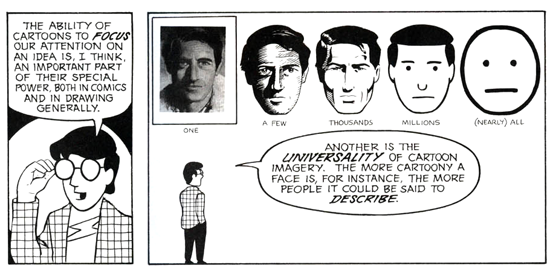
Scott McCloud's Understanding Comics touches on a lot of really solid points of the understanding comics in a very informative . What I found really interesting are the connections he made on a both broad and personal level. Being able to tie in both a large ideas of what comics are as sequential art down to the mastery of understanding the human mind to connect to the characters in the comics. What most resonated with me was the idea that McCloud related on icons and universality of it.
The idea of iconography isn't new to me. I understand creating images to relate ideas and themes, to send a message that can be universally understood and/or recognized. But the idea of connecting to that message through a personal relation is something I never really picked up on till now. Humanity's self love fueling a relationship and understanding with lifeless or inanimate objects is just so absurdly correct, insightful and makes total sense. Whats really great is the idea of this universality relates to all ages, although I'd say the younger you are the more attuned you are to these feelings.
Wednesday, August 21, 2013
Shaun Tan's The Awakening
Shaun Tan's The Arrival was a very different graphic novel than what I'm normally used to. It being without speech, for one, gave me somewhat of an incite in universal theme-ing that I'm not always paying complete attention to. Specifically, with text based stories, I find myself wrapped up in the literary aspect; pulling at the different strings of reference to come to conclusions of tone and meaning. With The Arrival, I found myself more gravitating to the imagery, of course, and the archetypal characters and themes. For instance, the allusion of immigration gave me a lot familiar ideas to grasp onto without needing the idea of direct speech handing me the answer, specifically story-wise. Although, at some points in the story I feel as if the metaphor was forced a little to hard as a result of relying so hard on image. Specifically when the father was going through his things when he was in his room and there was a frame of his family in the suitcase. Its pretty obvious what the idea is there, and if it weren't for the overall somewhat whimsical tone of the story, it would be completely out of place for me. The tone, also being somewhat strangely optimistic and simple also through me off somewhat in contrast to the hectic and loaded flashbacks of the characters.
I think having text in this specific story may have taken more away than what it may have added. Again, I would try to find some deeper meaning hidden in the obvious extended metaphor but really just miss the beautiful simplicity of the story. But more importantly, I think the story of immigration and that language barrier inherent adds to the luster of this commutation style in a way text would only detract from. The simple things like having the father communicate with an image in the story itself cements this idea pretty perfectly. I would struggle to find a better example or reason to have a speechless story than what Tan has shown
us here.
Subscribe to:
Posts (Atom)